
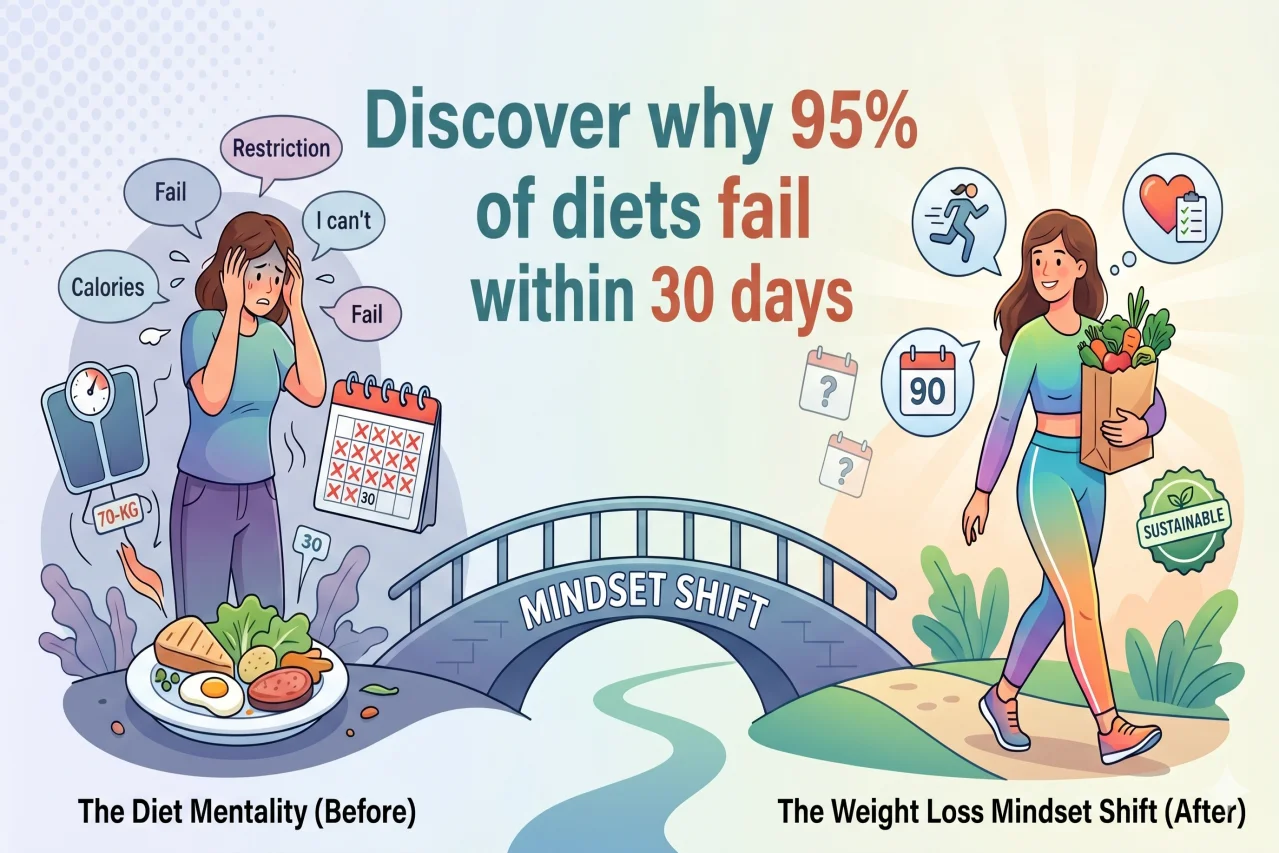
The reason most diets fail has nothing to do with your self-control — and everything to do with what you believe about yourself.
Why do 95% of diets fail within 30 days? Here’s the uncomfortable truth: it’s not about willpower. It never was.
Most diet programs sell you a plan. What they don’t sell you — because they can’t package it — is the psychology underneath lasting change.
Every January, millions of people launch into new diets with genuine conviction. They track every calorie, cut out entire food groups, and white-knuckle their way through social events. By February, the majority have quietly slipped back to old habits — often feeling worse about themselves than before they started.
This isn’t a failure of character. It’s a failure of framework. The fitness industry has spent decades teaching people what to eat while almost entirely ignoring why they eat the way they do. That gap — between information and understanding — is where sustainable weight loss either begins or dies.
| 95% of dieters regain weight within 1–5 years | 83% cite “lack of motivation” as the reason they quit | 2× more likely to succeed with a behavioral approach vs. diet-only |
Fixed vs. Growth Mindset in Weight Loss
Psychologist Carol Dweck’s research on mindset reveals a profound split in how people interpret challenge and failure. In the context of weight loss, this plays out with striking clarity.
Someone with a fixed mindset about their body believes that their relationship with food, their metabolism, or their “willpower” is essentially set in stone. When they slip up — eating a piece of cake at a birthday party — they interpret it as confirmation of a permanent flaw: “See? I have no self-control. I’ll never lose weight.”
Someone with a growth mindset sees the same situation completely differently. The cake isn’t a moral failure; it’s data. “I ate more than I planned because I was stressed about the presentation at work. What does that tell me about my patterns?”
| Fixed Mindset | Growth Mindset |
| I have no willpower I’ve always been like this One slip = total failure I’m just not built for this Motivation is what I need more of | I’m learning what works for me Patterns can change with practice One slip is one data point I’m building systems, not relying on genes Understanding is what creates lasting change |
The shift between these two stances isn’t just motivational — it’s neurological. People with a growth mindset engage different problem-solving centers of the brain when facing setbacks. They’re literally thinking differently, not just feeling differently.
“Lasting weight loss isn’t something that happens to you. It’s something you build — one small, informed decision at a time.”
The Knowledge Gap: Knowing Why vs. Just How
Walk into any bookstore and count the diet books. There are thousands of them. Now ask yourself: if information were the answer, wouldn’t we have solved obesity decades ago?
The real problem isn’t a shortage of “how.” It’s a shortage of “why.” Most of us know that vegetables are better than chips. We know that sleep affects metabolism. We know that stress and overeating are connected. Knowing these things, however, is not the same as understanding why we keep doing the opposite.
The knowledge gap is the distance between intellectual understanding and embodied behavior. Closing it requires more than reading another article about macros. It requires genuine curiosity about your own internal patterns — the kind of curiosity that replaces shame with inquiry.
Consider two people who both know that eating late at night leads to weight gain. The first person hears this as a rule to follow — and feels guilty every time they break it. The second person gets curious: When do I eat late? What was I feeling? What had happened earlier that day? After two weeks of honest observation, they discover they always raid the fridge after tense phone calls with a particular family member. That’s not a calorie problem. That’s a coping mechanism problem — and it requires a fundamentally different solution.
Knowledge, in this context, isn’t just information. It’s self-knowledge. And self-knowledge is the only foundation on which sustainable weight loss can be built.
What To Do (and What Not To Do)
Three Daily Mindset Check-ins That Actually Work
You don’t need to spend an hour journaling every day. You need three minutes and three honest questions. Practised daily, these check-ins rewire how you relate to food, your body, and your habits.
- Morning: Set your intention (not your goal): Ask yourself: “What kind of person do I want to be today around food and my body?” Not “I’ll eat 1,400 calories” — but “Today, I want to be someone who eats mindfully and doesn’t use food to manage stress.” Identity-based intentions outlast targets.
- Midday: The pattern pause: At lunch or mid-afternoon, take 60 seconds to notice: “How am I feeling right now — physically and emotionally? Is there any pull toward food that isn’t about hunger?” Name what you observe without judgment. Naming breaks the automatic loop.
- Evening: The reflection without verdict: Before bed, ask: “What happened today that I want to understand better?” Not “Did I succeed or fail?” but “What did I learn?” Write one sentence. Over weeks, patterns emerge that no calorie tracker can reveal.
These three questions, asked consistently, will teach you more about your relationship with food than any elimination diet ever will. They shift you from being a passive follower of rules to an active student of yourself — and that shift is everything.
The Right Tool for the Journey
Recommended Tool — Habit Tracking

A Dedicated Habit & Mindset Journal
The three daily check-ins above are most powerful when written down. A structured journal — one with dedicated space for emotions, patterns, triggers, and intentions — creates the paper trail of self-knowledge that transforms insight into lasting change. Look for journals with guided prompts specifically designed for habit tracking, not just blank pages.
Browse on Amazon
The Mindset Shift Is the Work
We live in a culture that rewards dramatic transformation and overnight results. The weight loss industry profits from this impatience — selling us cleanses, detoxes, and 30-day challenges that generate short-term results and long-term dependency.
The quiet, unsexy truth is that sustainable weight loss is a byproduct of sustainable self-understanding. When you know why you eat what you eat, you stop needing to white-knuckle every meal. When you understand your emotional triggers, they lose their unconscious power. When you adopt a growth mindset, every setback becomes a stepping stone rather than a tombstone.
None of this requires a gym membership, a meal kit subscription, or an expensive coaching program. It requires honesty, curiosity, and a willingness to look at yourself without flinching.
That’s hard. But it’s the right kind of hard — the kind that actually leads somewhere.
Before you go: one question
“What’s one belief about your body or willpower that you need to unlearn?”
Drop it in the comments. You might find you’re not the only one carrying it — and that’s the first step to putting it down.
Q. If willpower isn’t the answer, what actually drives lasting weight loss?
Lasting weight loss is driven by self-knowledge and systems, not sheer determination. Willpower is a finite resource that depletes throughout the day — it was never designed to carry the full weight of behavior change. What works long-term is understanding your personal patterns (when you eat, why you eat, what triggers certain choices) and then building an environment and routine that makes healthier choices easier by default, rather than relying on motivation that fluctuates daily.
A fixed mindset in weight loss is the belief that your relationship with food, your metabolism, or your capacity for discipline is permanent and unchangeable — something you either have or you don’t. It holds people back because it turns every slip-up into confirmation of a flaw rather than useful information. Someone with a fixed mindset who eats off-plan thinks “I have no self-control”; someone with a growth mindset thinks “what was happening when I made that choice?” The first shuts down learning; the second opens it up.
It means expanding what you record beyond just food quantities. Note the time, your emotional state, your hunger level, and what had happened in the hours before each eating decision. Over two to four weeks, genuine patterns emerge — you might discover you always overeat on Sunday evenings after family calls, or that you reach for snacks at 3pm only on days with back-to-back meetings. Calorie counts tell you what happened; pattern tracking tells you why — and the why is what you can actually change.
Most diets are built on restriction and rules, with motivation as the only engine. Motivation peaks at the start of any new goal and drops sharply within days or weeks — which is entirely normal and has nothing to do with character. When motivation dips, the diet has no other mechanism to keep going. Add to this that most diets never address the emotional and psychological triggers underneath eating behaviour, and you have a system almost engineered to fail. Sustainable change requires understanding, not just instructions.
Most people notice a shift in awareness within one to two weeks — you start catching yourself mid-pattern rather than realizing after the fact. Behavioral change typically takes longer: research on habit formation suggests meaningful rewiring takes 8–12 weeks of consistent practice. The check-ins aren’t a quick fix; they’re a daily practice that compounds. Think of them the way you’d think of brushing your teeth — the results aren’t dramatic day to day, but the absence of the habit is very clearly felt over time.
It can absolutely be unlearned — or more accurately, replaced with more intentional responses. Emotional eating is a coping mechanism that developed for a reason: it works, at least in the short term, to reduce emotional discomfort. The goal isn’t to shame yourself out of it but to gradually introduce alternative coping strategies (movement, journaling, calling someone, breathing exercises) and to catch the emotional trigger earlier, before the eating response kicks in automatically. That shift happens through consistent self-awareness, not willpower alone.


