
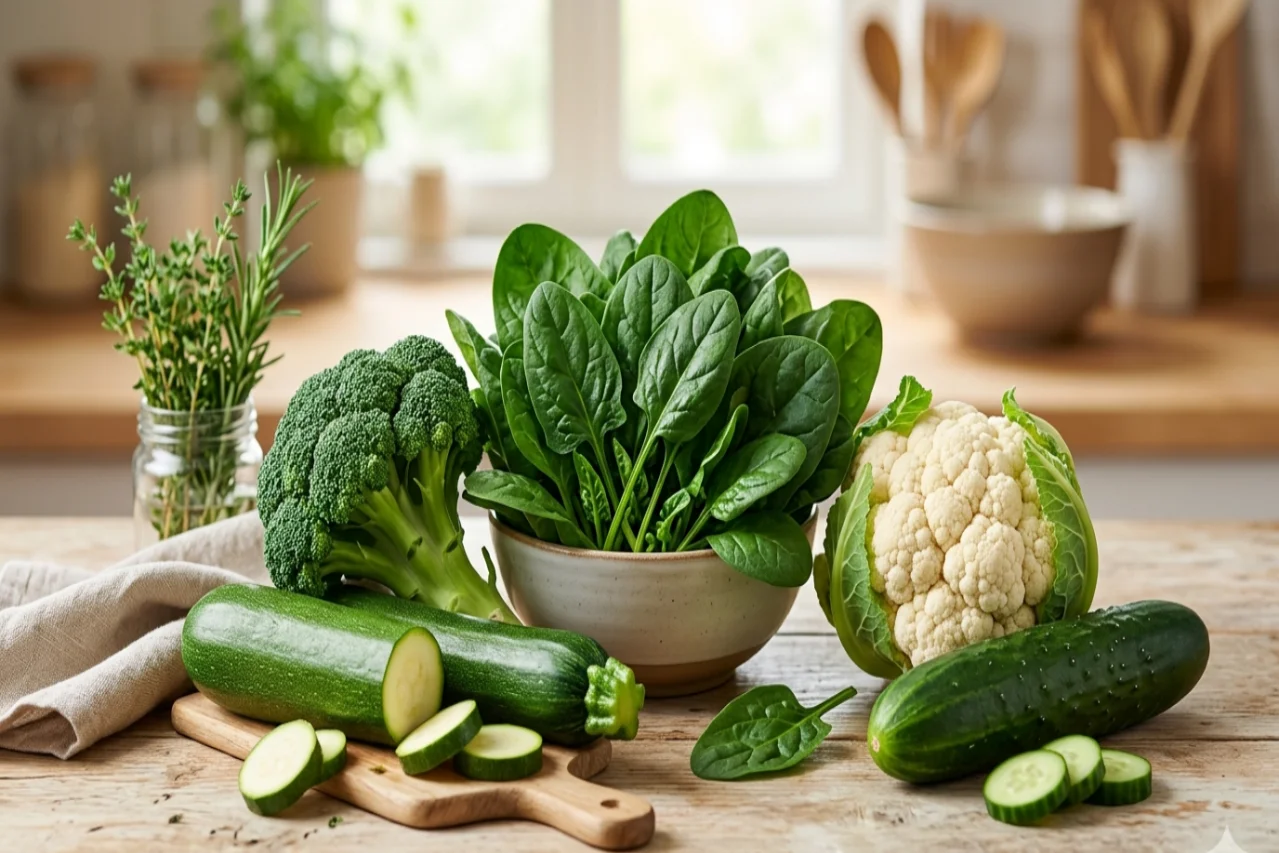
What if the grocery shop already held the key to weight loss without hunger? According to scientific research, eating more veggies really speeds up fat loss since they are so high in fiber, water, and vitamins and low in calories. The top five veggies for weight reduction are broken down in this article, along with the reasons for their effectiveness and the simplest ways to incorporate them into your regular diet.
Best vegetables for weight loss | how to eat more and lose weight | low calorie high volume foods | high fiber vegetables for fat loss | weight loss meal prep vegetables
Why Certain Vegetables Make You Lose Weight Faster
When it comes to losing fat, not all vegetables are made equal. Three essential characteristics are shared by the most effective ones: very low caloric density, which allows you to consume huge amounts for very few calories; high dietary fiber, which slows digestion and stabilizes blood sugar; and very high water content, which adds physical bulk and indicates fullness.
This combination—scientifically known as “volumetrics eating”—allows you to maintain the calorie deficit required for steady fat reduction while eating larger meals and feeling fuller for longer. Without intentionally limiting portions, those who followed a high-vegetable, high-volume diet consumed an average of 400 fewer calories daily in research trials.
Pro tip: Pair any of these vegetables with a lean protein source (chicken breast, eggs, legumes) to further blunt hunger hormones and protect muscle mass during weight loss.
1. Spinach: 7 cal / cup
Spinach is one of the best low-calorie veggies for weight loss. Just 23 calories can be found in a whole 100g serving of raw spinach, which also contains 2.9g of fiber, a substantial amount of iron, magnesium, and vitamins A, C, and K.
| 23 calories per 100g | 91% water content | 2.9g fiber per 100g |

Why it works for fat loss
Spinach is rich in thylakoids—membrane compounds shown in research to reduce hunger by delaying fat digestion and increasing satiety hormones. One Swedish study found that participants who consumed thylakoid-rich spinach extract experienced significantly reduced cravings for high-fat, high-sugar foods throughout the day.
Its near-zero caloric density means you can fill half your plate with spinach and barely move your calorie count. It’s the ultimate high-volume, low-calorie food for anyone trying to eat more while weighing less.
How to use it
- Morning smoothies — two large handfuls add nutrients without changing flavor
- Salad base — replace iceberg lettuce entirely for a nutrition upgrade
- Stir-fries and curries—wilts dramatically, allowing you to eat large volumes cooked
- Egg scrambles and omelets—pair perfectly with protein for a filling, fat-burning breakfast
★ Amazon pick: Organic spinach powder (like Micro Ingredients Organic Spinach Powder is a convenient way to hit your daily spinach quota—ideal for smoothies, soups, and baked goods. Look for cold-processed options to preserve thylakoid content. Browse now on Amazon
2. Broccoli: 34 cal / cup
Broccoli is one of the most well-researched fat-loss superfoods available. It delivers a rare combination of high fiber (2.6g per 100g), significant plant protein (2.8g per 100g), and powerful anti-inflammatory compounds — all for roughly 34 calories per cup.
| 34 calories per cup | 2.8g protein per 100g | 89% water content |

Why it works for fat loss
Broccoli contains sulforaphane, a bioactive compound extensively studied for its ability to reduce inflammation, improve insulin sensitivity, and support healthy gut bacteria — all key mechanisms in sustainable weight management. Improved insulin sensitivity directly translates to less fat storage, particularly around the abdomen.
The fiber content of broccoli is particularly effective at slowing gastric emptying, meaning you feel full for longer after meals. Combined with its protein content — high for a vegetable — broccoli actively reduces ghrelin (the hunger hormone) more than most other vegetables.
Best cooking methods for weight loss
- Steamed — preserves the most sulforaphane and nutrients
- Air-fried with olive oil spray — satisfying crunch at minimal extra calories
- Raw in salads — maximum fiber intact, great for meal prep
★ Amazon pick: A high-quality vegetable steamer or electric food steamer (like the Hamilton Beach Digital Steamer) makes it effortless to batch-steam broccoli for the week. Pair with a meal prep container set for easy portion control. Browse now on Amazon
3. Zucchini: 17 cal / 100g
Zucchini has emerged as one of the most popular low-carb vegetable substitutes for a very good reason: it replaces calorie-dense carbohydrates at a fraction of the energy cost. A cup of pasta contains roughly 220 calories; a cup of zucchini noodles (zoodles) contains just 20.
| 17 calories per 100g | 95% water content | −200+ calories saved vs pasta |

Why it works for fat loss
Because of its exceptional water content (95%), zucchini physically fills your stomach while providing very little calories. It is one of the most adaptable vegetables for weight loss because of its mild flavor; it absorbs sauces and seasonings well, making eating healthily fun rather than taxing.
Zucchini is an essential pantry item for anyone trying to lose weight on a low-carb or ketogenic diet. It fulfills the psychological need for full, starchy carbohydrates without upsetting ketosis or raising blood sugar levels.
How to use it
- Zoodles (zucchini noodles) — with marinara, pesto, or stir-fry sauces
- Zucchini boats — hollowed out and stuffed with lean turkey mince
- Grilled slices — as a side dish or sandwich layer
- Added to smoothies raw—virtually tasteless, adds volume and nutrients
★ Amazon pick: A spiralizer (such as the OXO Good Grips 3-Blade Spiralizer) transforms zucchini into satisfying noodles in seconds and works equally well with cucumber, carrot, and sweet potato — making it one of the most useful tools for a weight-loss kitchen. Browse now on Amazon
4. Cauliflower 25 cal / 100g
Cauliflower has had a major nutritional glow-up. It’s evolved from an overlooked side dish into the reigning champion of low-carb swaps. Whether it’s riced, turned into a pizza crust, or whipped into “mashed potatoes,” this incredibly versatile veggie lets you enjoy your favorite comfort foods while slashing hundreds of calories from every serving.
| 25 calories per 100g | 92% water content | 2g fiber per 100g |

Why it works for fat loss
As a cruciferous vegetable, cauliflower shares broccoli’s sulforaphane and anti-inflammatory compound profile. Its low glycemic index means it produces minimal blood sugar response — critical for controlling insulin levels and avoiding the energy crashes that trigger overeating.
The satiety index of cauliflower rice is significantly higher than equivalent-calorie portions of white rice, according to volumetrics research. This means you feel full sooner and stay full longer — the holy grail of sustainable calorie reduction.
Best cauliflower swaps for weight loss
- Cauliflower rice vs white rice—saves approx. 175 calories per cup
- Cauliflower mash vs mashed potatoes—saves approx. 130 calories per cup
- Cauliflower pizza base vs regular dough—saves approx. 300 calories per pizza
- Cauliflower “steaks” — filling, protein-paired main dish
★ Amazon pick: Frozen riced cauliflower bags (Green Giant or Birds Eye) eliminate all prep work and are freezer-stable for weeks — a game-changer for consistent healthy eating. Also consider a food processor for batch-ricing fresh cauliflower heads in under 60 seconds. Browse now on Amazon
5. Cucumber: 16 cal / 100g
Cucumber is perhaps the most underrated weight-loss vegetable in existence. At 96% water content and just 16 calories per 100g, it is one of the most hydrating, hunger-suppressing, and snack-able foods you can eat. Research consistently shows that even mild dehydration is misinterpreted by the brain as hunger—cucumbers directly combat this.
| 16 calories per 100g | 96% water content | 0.5g fat per 100g |

Why it works for fat loss
The combination of very high water content and mild crunch makes cucumber uniquely effective as a snack replacement for chips and crackers. Swapping your afternoon 200-calorie chip snack for a full bowl of cucumber slices with hummus typically cuts over 100 calories while providing significantly more satiety due to the volume and water content.
Cucumbers also contain cucurbitacins — bitter compounds shown to have anti-inflammatory and blood-sugar-regulating properties. Their silica content supports connective tissue health, which matters particularly for people losing significant weight.
How to use it
- Sliced with hummus or tzatziki — the ultimate guilt-free snack
- Cucumber water — naturally flavored hydration that displaces sugary drinks
- Salad base — mixed with tomato, red onion, and feta for a satisfying side
- Cucumber “sushi” rolls — thinly sliced lengthwise, wrapped around tuna or avocado
★ Amazon pick: A glass water infuser pitcher (like the Prodyne Fruit Infusion Pitcher) makes cucumber water effortless and beautiful — a simple daily habit that reduces hunger, improves hydration, and displaces high-calorie beverages. Also great with lemon and mint.
Quick Comparison: The 5 Best Weight Loss Vegetables at a Glance
| Vegetable | Cal/100g | Water % | Fiber/100g | Best use |
|---|---|---|---|---|
| Spinach | 23 | 91% | 2.9g | Smoothies, salads |
| Broccoli | 34 | 89% | 2.6g | Steamed, stir-fry |
| Zucchini | 17 | 95% | 1.1g | Noodles, boats |
| Cauliflower | 25 | 92% | 2.0g | Rice, pizza base |
| Cucumber | 16 | 96% | 0.5g | Snacking, water |
Frequently Asked Questions
1. Can eating more vegetables really help you lose weight without cutting calories drastically?
Indeed, this is the fundamental idea of volumetric eating. Because vegetables like spinach, cucumber, and zucchini have such a low calorie density, you can consume much more food while still sustaining the mild deficit required for fat loss. Because the sheer amount of food stretches the stomach, releases satiety hormones, and slows gastric emptying, studies reveal that high-vegetable dieters naturally consume 300–500 less calories per day without feeling hungry. The secret is to swap out calorie-dense foods like bread, pasta, and rice with these volume-rich substitutes rather than merely adding veggies to a diet that is already high in calories.
2. Which vegetable is the single best for weight loss?
If forced to choose one, spinach edges out the competition due to its near-zero caloric density (23 cal/100g), high thylakoid content (shown to reduce cravings), versatility across both raw and cooked applications, and its extraordinary micronutrient density per calorie. That said, the research strongly favors dietary variety — different vegetables provide different fiber types, phytonutrients, and satiety mechanisms. The most effective weight-loss diet includes all five vegetables listed in this guide, rotated regularly throughout the week.
3. Are frozen vegetables as effective as fresh for weight loss?
In most cases, yes — and sometimes more so. Frozen vegetables are flash-frozen at peak ripeness, locking in nutrient content that can actually decline in “fresh” produce during transport and storage. Caloric density is essentially identical. Frozen broccoli, spinach, cauliflower rice, and zucchini noodles are just as effective for weight loss as fresh equivalents, and far more convenient for consistent meal prep. The only exception is texture — frozen vegetables tend to be softer after cooking, which matters for some preparations (raw salads, spiralized dishes) but not others (soups, stir-fries, smoothies).
4. How many servings of vegetables should I eat per day to lose weight?
Current evidence suggests that 5–9 servings per day (approximately 400–720g of mixed vegetables) provides the optimal combination of fiber, micronutrients, and satiety for sustainable weight loss. A practical approach is to fill half your plate with non-starchy vegetables at every main meal — a simple visual rule that naturally creates the calorie deficit needed for fat loss without counting calories. If you’re new to high-vegetable eating, increase intake gradually over 2–3 weeks to allow your gut microbiome to adjust and avoid digestive discomfort.
5. What kitchen tools make it easiest to eat more vegetables for weight loss?
The right equipment removes friction and dramatically increases vegetable consumption. The most impactful tools are: a spiralizer (for zucchini and cucumber noodles), a food processor or mini chopper (for cauliflower rice and pre-chopped salad prep), an electric steamer (for hands-free broccoli and spinach), a quality set of meal prep containers (for batch-cooking vegetables on Sundays), and a high-speed blender (for spinach and cucumber smoothies). All five categories have highly rated options available on Amazon, and investing in even one or two of these tools typically leads to a measurable increase in daily vegetable intake within the first week.
The Bottom Line
Sustainable weight loss doesn’t require eating less — it requires eating smarter. By strategically replacing high-calorie staples with spinach, broccoli, zucchini, cauliflower, and cucumber, you can eat more food, feel more satisfied, and consistently lose fat. Start with one swap per meal this week: cauliflower rice instead of white rice at dinner, or a spinach smoothie instead of a pastry at breakfast. Small, compounding changes built around these five vegetables are genuinely one of the most evidence-backed paths to lasting weight loss.
Disclosure: As an Amazon Associate, we earn from qualifying purchases. All product recommendations are based on independent research and genuine utility for the reader.


